
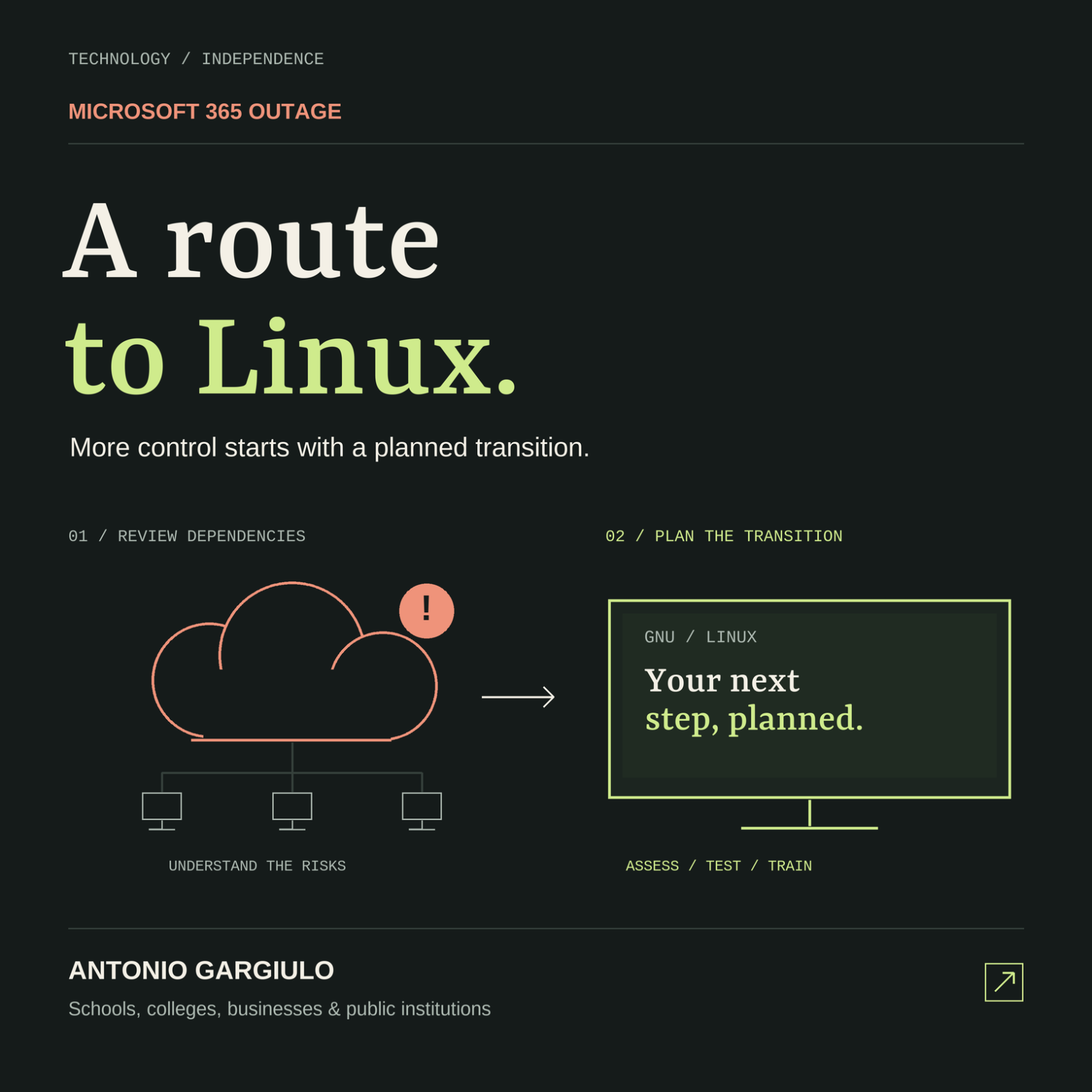
For years, I have argued that schools, colleges, businesses and public institutions should take GNU/Linux and free software seriously. The Microsoft 365 disruption that began on 12 November 2026 gives us another reason to have that conversation. Microsoft confirmed that the incident could affect service connectivity in any region, while education providers reported disruption to everyday work.[11][2][3]
My argument is not that Linux makes every technical problem disappear. I want organisations to have more control over the tools they depend on, and a workable plan for the moments when those tools become unavailable.
What actually stopped working?
The incident affected Microsoft 365 services, rather than every Windows computer. Cypress College identified problems with Outlook, Exchange Online mailboxes, SharePoint Online and Microsoft 365 Copilot. Users could have trouble loading their inboxes, sending or receiving email, and connecting to Microsoft 365 applications.[2]
Colorado School of Mines reported affected services including email, Teams, OneDrive and Word online. Its guidance described Word and Office 365 web and desktop applications as largely unavailable, and recommended alternatives such as Google Docs. Orange County Department of Education also confirmed that staff could not send or receive Outlook email.[3][4]
That is serious disruption. It is also more precise than saying that all Microsoft software stopped working everywhere. The effects varied between services and organisations.[2][3][4]
Why I keep arguing for free software
When I talk about free software, I mean freedom as well as price: the ability to run, study, modify and redistribute the software. That is the distinction made in the GNU project’s free-software definition.[14]
For me, the attraction is the opportunity to decide which tools an organisation uses, who supports them, and how much essential work should depend on an external service.
Installing Linux alone would not remove a Microsoft 365 dependency. My assessment would therefore cover the applications, accounts, documents and working practices together, rather than treating an operating-system installation as the whole job.
I would look particularly closely at which tasks need to remain possible during an internet or cloud-service outage. Basic document work deserves a continuity plan just as much as the more specialised systems.
European institutions have already explored this route
There are genuine examples behind the headlines, but individual institutions adopting Linux is not the same as an entire country abandoning Microsoft.
In September 2026, Schleswig-Holstein announced that more than 200 State Chancellery employees were working on Linux. Around 20 workstations still had technical dependencies preventing a switch. The announcement also described staff training and support, and earlier moves to LibreOffice, Open-Xchange and OpenTalk.[6]
For parliaments, the European Commission’s portal carries a March 2007 report on the French National Assembly selecting Ubuntu for deputies and their assistants. That is a historical parliamentary example, not evidence that every French parliamentary system runs Linux today.[7]
Tax administration needs a qualification. Lower Saxony’s tax authority migrated its Solaris desktop environment to SUSE GNU/Linux in 2006, in a project covering roughly 14,000 desktop computers. However, a later Commission report documented its decision to phase out Linux-based workstations. It would be misleading to present the original migration as an uninterrupted, current success story.[15][12]
There is also a pensions example. An OpenText/Micro Focus case study published in 2023 describes the German Pension Fund Baden-Württemberg migrating COBOL applications from z/OS to SUSE Linux Enterprise Server. This was an application and server-platform migration involving commercial software, not a wholesale conversion to exclusively free software.[9]
My conclusion is that Linux deserves serious consideration, alongside an honest assessment of compatibility and long-term support.
The expertise is in planning the transition
I would not advise a school or business to replace every computer overnight because an outage made the headlines. I would start with the work people actually need to do.
My proposed process would include:
- Reviewing applications, licences, hardware and support arrangements.
- Testing real documents, spreadsheets, macros, accessibility requirements and specialist software.
- Identifying tasks that need offline access and services that need a fallback.
- Running a small pilot with the people who will use the system.
- Planning training, backups, ongoing support and a rollback before a wider rollout.
LibreOffice is available for Windows, macOS and GNU/Linux. That provides an opportunity to evaluate a different office suite before deciding whether to change the operating system too.[13]
I would expect testing to expose exceptions. A department may need to retain a particular application or use a mixed environment. My priority would be a transition people can work with, with clear reasons for each decision.
The budget also needs to include the migration itself. My proposal would account for staff time, compatibility testing, training and maintenance, instead of treating a zero licence price as a zero-cost project.
A practical route towards more control
I have supported GNU/Linux and free software for years. I want to turn that position into a practical discussion about your organisation: what can change, what needs to stay, and how to move without interrupting essential work.
If your school, college, business or institution is considering a transition, contact me. I can help you assess the options and develop a phased plan around the people who will use it.
References
Reference numbers match the original article. Click any numbered citation to open its source. The full source addresses are listed below. The GNU definition at [14] is an archived copy dated 8 April 2018.
[2] Cypress College: Update, Microsoft Outage, 12 November 2026
https://www.cypresscollege.edu/2026/11/12/update-microsoft-outage
[3] Colorado School of Mines: Global Microsoft 365 Outage and Service Workarounds
https://helpcenter.mines.edu/TDClient/1946/Portal/KB/Article/166149/Global-Microsoft-365-Outage-Service-Workarounds
[4] Orange County Department of Education: Microsoft outage, 12 November 2026
https://newsroom.ocde.us/nationwide-microsoft-outage-disrupts-email-services-for-ocde-other-organizations
[6] Schleswig-Holstein: State Chancellery uses Linux, 19 September 2026
https://www.schleswig-holstein.de/DE/landesregierung/ministerien-behoerden/I/Presse/PI/2026/cds/260919_cds_linux_stk
[7] Interoperable Europe: French Parliament selects Ubuntu, 12 March 2007
https://interoperable-europe.ec.europa.eu/collection/egovernment/news/fr-parliament-selects-ubuntu
[9] OpenText: German Pension Fund Baden-Wurttemberg case study, 2023
https://www.microfocus.com/media/success-story/german_pension_fund_baden_wurttemberg_ss.pdf
[11] Microsoft 365 Status: worldwide connectivity disruption, 12 November 2026
https://x.com/MSFT365Status/status/2120941584220827979
[12] Interoperable Europe: Lower Saxony announces Linux phase-out
https://interoperable-europe.ec.europa.eu/collection/open-source-observatory-osor/news/win-some-lose-some
[13] LibreOffice: System requirements
https://www.libreoffice.org/system-requirements
[14] GNU: What is free software? Archived 8 April 2018
https://web.archive.org/web/20180408022200/www.gnu.org/philosophy/free-sw.en.html
[15] European Commission OSOR: Migration XXL, historical case study
https://interoperable-europe.ec.europa.eu/sites/default/files/document/2012-02/migrationxxl.pdf